
Hi, I'm Emerson
I'm a disabled content creator with a focus on chronic illness. I try to support my community by spreading awareness and sharing resources.
Follow me on TikTok
Follow me on Insta
Disability Resources List
Medical Info
This page is a repository of links to useful medical information, with a focus on chronic illness and COVID-19. I recommend reading through Long COVID Sux as a starting point for COVID information.
You don't really need to read all of the sciencey stuff to understand that COVID is a real and present threat, and that masks are a useful and important way to protect yourself.
Yes, COVID Is Still Here
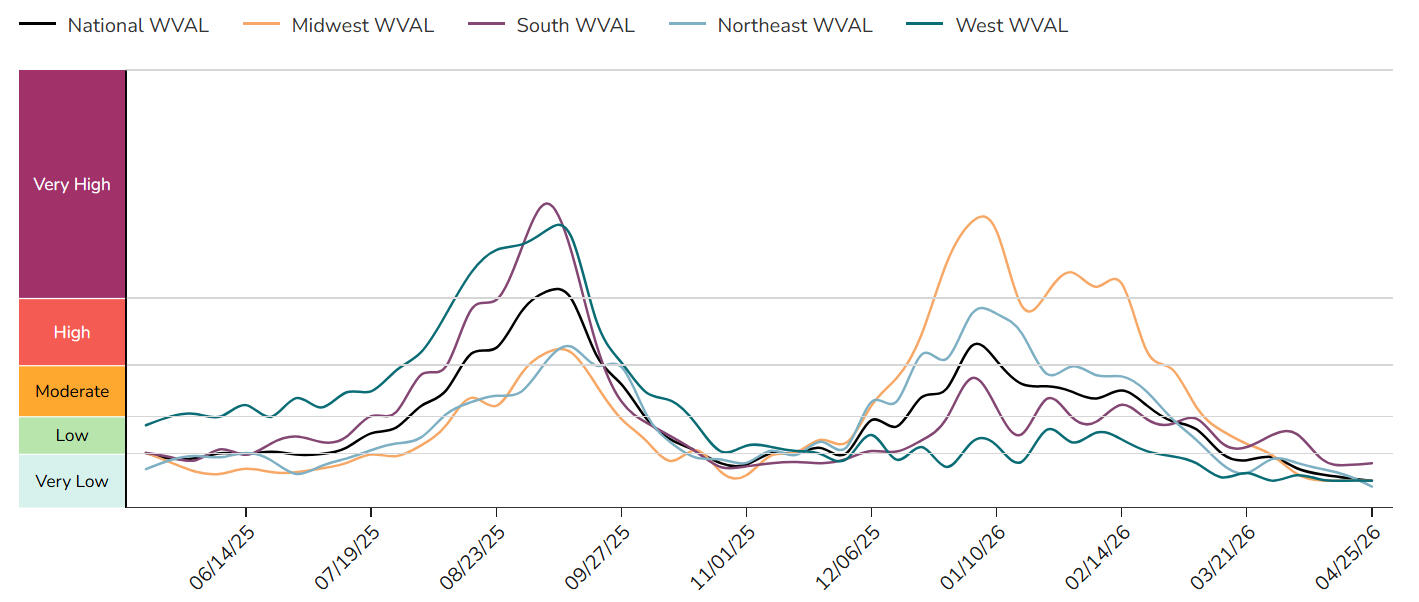
This is the wastewater data from the US CDC showing the national and regional trends of wastewater viral activity levels of COVID-19.
As you can see, it still exists and even enters the 'Very High' category in some places during spikes.
Click the graph to go to the CDC website and see the data for yourself
COVID Info - Not Too Sciencey
An overview of the symptoms, diagnosis, and treatment of Long-COVID.
A good introduction to the damage that COVID can do to the body, scroll down for testimonies and an interactive graphic showing the damage to specific parts of the body.
A repository of information on COVID impacts. "This site is an ongoing collaborative project since 2022, highlighting resources created from collective care and resistance to eugenics and fascism."
Features a presentation by Dr Nancy Malek, as well as a large number of references.
What COVID-19 Does to the Body (Eighth Edition, June 2025): COVID-19 Research Update (90+ Studies)
Covers the impact on children, multiple body systems, long-COVID/Disability, and mortality.
COVID Info - Sciencey
A literature hub for tracking up-to-date scientific information about the 2019 novel Coronavirus.
Long-term neurological and cognitive impact of COVID-19: a systematic review and meta-analysis in over 4 million patients
"Neurological symptoms are common and persistent in COVID-19 survivors"
COVID‑19 and HIV share chronic immune dysfunction, persistent viral reservoirs, systemic inflammation, accelerated biological aging, increased vulnerability to infections, and overlapping neurological impacts. They reach those outcomes through very different mechanisms.
More sources on COVID impacts on the body (to prevent this section being massive).
Masking Info
Personally I recommend wearing an FFP2 or FFP3 level mask if you can. I use FFP2s due to them being significantly cheaper than FFP3s, but I would buy FFP3s if not for the affordability aspect.
Sadly, COVID is airborne. The WHO and US EPA confirm it. The following sources will help you protect yourself and shows that masks work.
Differences between different types of masks.
For respirator masks: FFP2 is a European standard, N95 is an American standard, both provide the same level of protection.
FFP3 provides a higher level of protection.
Surgical masks do not offer the same level of protection.
Consistently wearing a mask indoors in public significantly reduces someone's chances of testing positive for COVID.
N95/KN95 gave the strongest protection, followed by surgicals, and then cloth masks.
Masks, especially well‑fitted FFP2/N95s, hugely outperform social distancing.
Just social distancing (3 metres): 90% infection risk within minutes
If only the uninfected person masks:
Surgical: upper-bound risk is 90% after ~30 mins
Well-fitted FFP2/N95: 20% even after an hour
If both wear masks:
Surgical: risk says below 30% after an hour
Well-fitted FFP2/N95: risk is 0.04% (near zero)
The fit matters massively. A poorly fitted FFP2 leaks more than a well-fitted one.
Google Doc of Studies on the safety of expired N95’s (compared to new N95’s and new surgical masks)
Overall, expired respirator masks are better than a new surgical mask
More sources on COVID impacts on the body (to prevent this section being massive).
Where I order masks
Not an endorsement, it's just somewhere I have ordered from, it's cheaper to order in bulk and they sometimes do pretty good offers.
You can order from sites like Amazon, but I tend to avoid it for ethical and quality reasons.
Chronic Illness Info
The sorts of chronic illnesses I am focusing on are a kind of bubble of related conditions which include Long COVID, Myalgic Encephalomyelitis, Fibromyalgia, and other related conditions. There is not a hard and fast rule, it's more to do with people who have similar experiences to me. I focus on conditions that can be caused by COVID, as that is what disabled me.
Covers the basics of Myalgic Encephalomyelitis (ME), also known as Chronic Fatigue Syndrome (CFS).
Also describes Post-Exertional Malaise (PEM), the hallmark symptom of ME.
Chronic Illness Testimonies
Multiple testimonials including video interviews and written testimonials.
Also includes research talks and interviews.
My experience of chronic illness and mental health by Laura, 21
Liz's story with ME/CFS, living 27 years with an illness has not been treated or gotten better.
An audio interview with three ME patients as well as some written information about ME.
University While Chronically Ill
The resources here are aimed at supporting chronically ill people who are at University or are considering it, but it would be great if it helps other people too! Please keep in mind that I am not an expert, this is based on my own experience.
Each Section has a video, followed by a graphic, followed by plain-text of the information in the graphic.
Part One: Choosing a Course
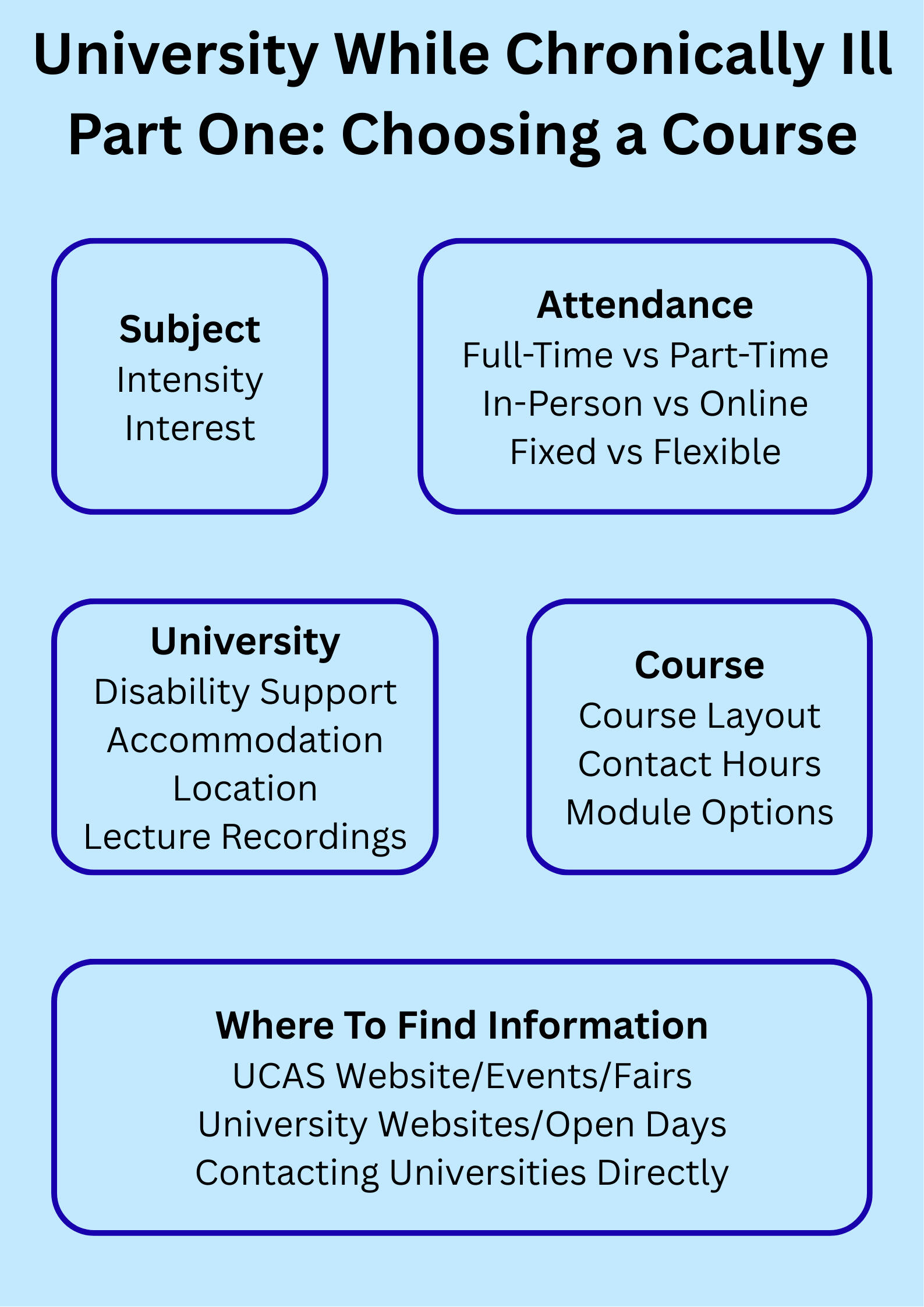
Plain Text of Graphic
University While Chronically Ill
Part One: Choosing a Course
Subject: Intensity, Interest
Attendance: Full-Time vs Part-Time, In-Person vs Online, Fixed vs Flexible
University: Disability Support, Accommodation, Location, Lecture Recordings
Course: Course Layout, Contact Hours, Module Options
Where To Find Information: UCAS Website/Events/Fairs, University Websites/Open Days, Contacting Universities Directly
Sciencey COVID Sources Continued
Mapping brain changes in post-COVID-19 cognitive decline via FDG PET hypometabolism and EEG slowing
"in patients with persistent subjective cognitive decline after mild COVID-19 we identified concomitant PET hypometabolism and EEG slowing patterns in anterior brain regions"
Neonates infected with SARS-CoV-2 have an increased risk of developmental delays
4% of children and 10%–26% of adults developed long COVID.
Excess incidence among SARS-CoV-2 patients was 1.5% in children and ranged from 5% to 6% among adults.
SARS‑CoV‑2 and HIV share the feature that both cause long‑lasting depletion and dysregulation of key lymphocyte subsets (especially CD4⁺, CD8⁺, NK, and B cells) resulting in chronic immune compromise that persists long after infection.
Post‑COVID patients show a clear, measurable reduction in brain cellular energy production (specifically lower ATP/PCr ratios in the cingulate cortex) indicating mitochondrial dysfunction that correlates with cognitive impairment. Similar to ME.
Masking Sources Continued
How effective is a mask in preventing COVID-19 infection?
"For inhalation protection, air filtering respirators such as N95 masks can filtrate contaminants, bacteria and other matters from reaching nose and mouth, and are more efficient in virus penetration inhibition than surgical masks."
Masks and respirators for prevention of respiratory infections: a state of the science review
"masks are, if correctly and consistently worn, effective in reducing transmission of respiratory diseases"
"respirators are significantly more effective than medical or cloth masks"
Looking at exhalation, not inhalation, cloth masks are worse than both respirators and surgical masks.
Cloth masks filter poorly, generally 2.5%–10% of ~1.5 µm particles. Bad in comparison to respirators.
Economic Impacts of COVID/Long-COVID
The Economic impacts of COVID-19 and Long-COVID, this section is likely to go more in-depth as Economics is my area, so I can offer more analysis. I will put my analysis in italics like this.
Long COVID is now a major chronic disease burden. It is a chronic condition with economic and social impacts comparable to major non‑communicable diseases.
Long COVID is a multisystemic post‑viral condition, which is real, persistent, and poorly understood. It's not one disease, but a cluster of related syndromes with different biological mechanisms, this includes immune dysregulation, inflammation, and possible viral persistence.
Projected prevalence for 2025-2035 is 0.6-1.0% of the population at any given time. This is lower than the >5% of the population on average across OECD countries in 2021, but millions have still been left chronically ill, and it evidently has not disappered.
There is an enormous economic impact. The direct healthcare costs alone total USD 53 billion in 2021 alone and are expected to stabilise at USD 11 billion per year for the next decade.
The indirect costs are even bigger, and include:
Reduced productivity
Absenteeism
Presenteeism
People leaving the workforce
Early retirement
Disability claims
With studies showing 1 in 5 workers with Long COVID experience employment disruption, equivalent to a 5–10% loss of labour input per affected person.
And the whole presenteeism/absenteeism thing is why I don't see the point in chronically ill/disabled people being in jobs that we are not capable of, some people are so blinded by their hatred of people on benefits that they stop being logical about it. Because genuinely what is the point in being employed if you cannot do the job?
Long COVID is projected to reduce GDP by: 0.1–0.2% every year, equivalent to USD 135 billion annually across OECD countries. This is comparable to the entire annual health budget of the Netherlands or Spain.
I am not someone who puts much belief into GDP as a metric, but $135 billion is a massive amount of money, even 0.1-0.2% of GDP of a single country is a large amount of money. According to the House of Commons Library, UK GDP in 2025 was £3,040 billion in cash terms in 2025, so 0.1-0.2% of that would be £3-6 billion lost due to Long-COVID.
Healthcare systems are struggling to cope, only six countries have formal national care pathways (Austria, Belgium, France, Germany, Luxembourg, Netherlands), and many Long COVID clinics created during the pandemic have since been closed or downsized this one has affected me personally.
The report also hightlights:
Uneven recognition of long COVID across countries
Inconsistent diagnostic criteria
Lack of standardised care pathways
Insufficient training for healthcare workers
Limited access to multidisciplinary care
Poor integration between health, disability, and employment systems
Many countries also lack cross‑sector coordination between health, employment, and social services, which makes it easy for people to fall for the cracks.This lack of integration is further excacerbated by how awful the social safety net is in many countries for this sort of condition.
Most countries do not have Long COVID‑specific disability policies and rely on general disability systems, which often fail to recognise fluctuating or invisible symptoms. Personally I think this lack of recognition is deliberate so they can avoid having to pay out benefits.
This all leads to delayed or denied disability benefits, people falling out of the workforce, and increased poverty risk among Long COVID patients.
I personally can attest to some of these being an issue in my own life. My ongoing battle with the DWP for disability benefits being one example.
So basically the OECD has said this needs a whole-of-government response, it cannot just be left to the health sector. Their key recommendations being:
National Long COVID strategies
Standardised diagnostic criteria
Dedicated care pathways
Better training for clinicians
Integrated multidisciplinary care
Stronger social protection and disability support
Workforce reintegration programmes
Continued research into mechanisms and treatments
Better surveillance and long‑term follow‑up systems
The OECD also stresses that Long COVID should inform future pandemic preparedness, especially when it comes to long‑term sequelae of infections. Long-term sequelae are chronic, pathological conditions resulting from a prior disease. I had to google that one.
Do I expect any of this to happen anytime soon? No, not really. Most politicians seem to be playing a game of 'who can bury their head in the sand hardest?' when it comes to all chronic illnesses, and that very much extends to Long COVID. The UK Government recently cut disability benefits, so they want to do nothing to cure/prevent Long COVID, whilst punishing the people who have it.
To conclude, Long COVID is here and it's not going away. It is both under‑recognised and under‑treated.
And without coordinated policy action, it will continue to drain health systems, economies, and human lives.
So cheery stuff, eh? It's a shame most people refuse to wear a mask or even acknowledge how serious it is. But what would I know? I'm just an Economist who had my life ruined due to a COVID infection.
So based on all of this information, investing money into research and treatment for Long COVID and other chronic conditions would be a boon for the UK economy. The government spending would boost GDP in the short-term and drive growth whilst making the UK more enticing to investors; in the long-term treating and even curing these illnesses would massively increase total productivity by increading the productivity of people currently in the workforce and by making it so many more become able to work
Sadly, this plan makes too much sense, so I do not expect it to happen.
Time and money should also be invested into prevention, currently it's far easier to prevent catching COVID in the first place than it is to treat it (given that we don't have any treatments). This could include masking policies in hospitals, investments into clean air infrastructure, and awareness campaigns.
Disability Aids and Other Useful Things
Not saying you have to buy any of this, but this is a place to find stuff that I think is very useful to have.
I recommend buying FFP2 or FFP3 Masks or the equivalent from other countries like N95/KN95.
The Department for Work and Pensions
Trying to summarise all of the issues with the Deparment for Work and Pensions and how they treat disabled people would not be possible, but this page is going to cover some of the issues that I have noticed.
Conflation of Intelligence and Disability
In my experience, and in the stories I’ve heard from friends, there’s a pattern. The system often treats well informed, articulate disabled people with suspicion, as if understanding your own condition somehow makes you less disabled in their eyes.
There seems to be a psychological need to put people into neat categories, either disabled or not, and when someone doesn’t fit that stereotype, it makes them uncomfortable. Intelligence doesn’t magically negate disability, and we need to challenge the idea that it does, it’s a ridiculous mindset.
So many people have their knowledge and understanding of their conditions used against them by the DWP when applying for PIP, as if being informed about your own health magically undisables you. It’s a harmful and absolutely ridiculous assumption, and it needs to be called out for what it is.
Not Following Their Own Regulations
Under Regulation 4(2A), if a claimant cannot perform an activity on more than 50% of days, or if it takes more than double the amount of time, they must be treated as unable to perform it.
This is regularly ignored, leaving people with dynamic disabilitites without support, or forcing them to go to court. Unfortunately, there is no guarantee that the tribunal will enforce this regulation either.
Assessors are not Experts
Assessors are random medical professionals, meaning that someone with autism and complex chronic conditions could be assessed by a paramedic or a non-specialised nurse.
Claimants often have to explain what a condition is to the assessor before they can explain how it affects their ability to do tasks.
They often disbelieve people about their conditions and how they affect them despite having little to no authority on such matters. They also often just write down incorrect information.
Ignoring Safety Criteria
They ignore how the safety criteria should work and try to get proof of going to A&E due to injuries. Just because injuries are treatable at home doesn’t mean they aren’t too frequent for the activity to be safe. It makes people feel penalised for being stubborn and knowing basic burn/wound care or not having the energy to go to hospital.
How I Would Fix PIP
There are a number of things that need to be changed to fix PIP. In my opinion, there are many people who rely on PIP due to other services being poor or non-existent. So if these were fixed, fewer people would need it in the first place. So I suggest changes to other services and to PIP itself.
Other Services to Fix First
Social Housing: Build more social housing and ensure it’s truly accessible and available to those who need it, reducing reliance on PIP. This would also reduce UC housing cost.
Social Care: Reform and expand social care services so that people receive the support they need without having to claim additional benefits. This avoids paying more to private companies for worse care, avoids the need to pay out of pocket.
Healthcare Access: Make diagnosis and treatment (including occupational therapy, mental health care), and other essential services fully accessible without a long wait through the NHS to minimise private and out-of-pocket costs.
Chronic Illnesses and NHS Treatment: Many chronic conditions are currently under-treated on the NHS due to limited funding and a lack of access to emerging treatments. If more investment were directed into research and making these advanced treatments available, it could improve people’s health making them less reliant on support.
Universal Credit: Ensure that Universal Credit is sufficient to meet basic living expenses, so people aren’t forced to apply for PIP just to survive. Also make all disabled eligible for the one bed rate regardless of PIP outcome, and have extra allowances available to cover accessible accommodation.
Wheelchair and Mobility Aid Provision: Access to essential mobility aids, like wheelchairs, often depends on local NHS commissioning, leading to inconsistent provision (aka a postcode lottery). Standardise and improve these services and ensure equitable access, then fewer people would need to rely on PIP for mobility support.
Assistive Technology: Ensure that people have access to other forms of assistive devices like hearing aids, screen readers, and communication devices without excessive costs or delays.
Transportation Accessibility: Improve public transport accessibility to reduce the need for additional funding just to get around. If public transport is more accessible, fewer people need extra allowances for travel. Also make Wheelchair Accessible Vehicles easier to obtain and have a government scheme rather than relying on private providers like Motability.
Accessible Travel Concessions: Reform bus passes and railcards to be more inclusive and reduce the need for strict PIP criteria or paid for doctor’s letters. This would ensure that more disabled people can access public transport without extra barriers.
Inclusive Employment: Support employers to create genuinely inclusive workplaces so that people with disabilities can work if they want to, reducing the need to rely on PIP as a fallback income.
Community-Based Support: Expand community support networks and local services, so people have local resources to fall back on and are able to get to know the providers and each other.
Changes To PIP Itself
Needs-Based Assessment: Shift from a rigid point system to a more personalised, case-by-case assessment that focuses on each individual’s unique needs.
Eliminate Standard vs. Enhanced Tiers: Replace the broad, one-size-fits-all categories with more flexible and tailored support that reflects actual living costs and needs.
Holistic Support: Integrate PIP with existing services so that if someone needs extra financial support, it’s provided and accounts for housing, healthcare, and other aids already in place.